- Given Circumstances
- "Playwright's setting or all material in a playscript that delineates the environment - the special "world" of the play
- polar attitudes
- Environmental Facts
- condition, place, time
- year, time, season, time of day
- economic environment
- political environment
- social environment
- religious environment, formal and formal psychological controls
- "Do not assume anything"
- Previous Action
- In media res
- What the audience is told happened before the present action started
- "To the director, there is never any dull exposition but only a rec... etc."
- When an actor acts: ten ingredients present in any life encounter
- relationship
- objective
- obstacle
- strategy
- tactics
- text
- subtext
- interior monologue
- evaluation
- beats / beat changes / units
- Polar Attitudes
- "every character in a play is conditioned, as in real life, by the special world he is caught in, and he will hold specific attitudes
Wednesday, November 13, 2013
Play Analysis

Saturday, November 9, 2013
TPPP Speech
Mark Hill
One of my first experiences in IB Theatre that had a significant impact on me was my workshops with Mark Hill, who introduced to me the ideas of two brilliant practitioners, Anne Bogart and Tadashi Suzuki, as well as the philosophy of Japanese Butou Theatre. This was the first of my in-depth workshops with the physicality of theatre that laid the foundation for the rest of my high school career as an actor and director.
The study of spacial relations, for example, allowed me to gain an understanding of staging and the balance I have to keep in mind while choreographing a performance, and also the awareness I must have of my fellow actors when I am on stage myself. I did not know that I could 'focus ' both on what was in front of me and also my peripheral vision, yet this skill has aided me in my own performances and my theatre experience many times over.
Through this workshop, I also learned of the Suzuki value of aesthetics and the importance of making every moment of a performance dynamic and interesting, not necessarily through movement, but also through the use of 'dynamic stillness'. Being stationary does not mean 'being boring', and it is an actor's task to make every pose interesting for the audience to look at. This is not limited to the individual, but also to the ensemble as a whole, again tying into spacial relationships. I learned the differences between western and oriental theatre styles, with the west focused on the voice, positive space, and being centered in the chest, while Asian - particularly Japanese forms of theatre - have a focus on the body, negative space, and is very grounded with a person's center of gravity placed in the abdomen.
The use of both positive and negative space is important to make a scene interesting for an obvious. Through this workshop, I learned how to utilize levels, counterpoint, symmetry, and make other aesthetic choices to make a performance interesting for my audience and also learned to be more in touch with my body.
The Pillowman
 These workshops gave me a foundation with which to have a better understanding of theatre as a whole, and becme particularly important when the concept of post-modernist theatre, or PoMo, was introduced to me. I had always enjoyed theater from a layman's perspective, mearly admiring the performance at first-impression value rather than understanding any true substance behind the mise en scene or the style of the performances themselves. My first experience with PoMo, exemplified with my first readthrough of The Pillowman by Martin McDonagh, opened my eyes to the subtleties and different styles of plays. The raw writing and surrealistic elements of the script captured my attention as both a director and a scriptwriter, and I came to understand PoMo ideas such as 'narrator becoming a character', 'disturbed mentalities', and 'disrupted flow of time'.
The Odyssey
 Then, following, I had the opportunity to see post-modernist theatre with my own eyes, through the performance of The Odyssey by a Polish troupe. This was my first experience with a play in a language that I could not understand, and through it I came to realize the universal nature of theatre. Even with a language barrier, I was able to capture the essence of every scene and identify the post-modernist aspects of the play. I also, however, came to understand the importance of language, as though I believe I understood the foundation of the performance, I am also certain that there was much of the intended message lost through the lack of translation of the language, ideas, as well as the culture. However, in this performance, I also saw for myself the idea behind Suzuki's sense of aesthetics - every moment on the stage made a unique and strangely compelling image. Every moment of every scene was striking.
Mother Courage and her Children / Bertolt Brecht
 Another play I read and watched performed was Mother Courage and Her Children, by Bertolt Brecht, through which I studied and learned about Brechtian theatre. I had studied the concepts, such as the alienation or 'V-effect' before, as well as Brecht's philosophy that the audience should not immerse themselves emotionally into a play, but I did not truly understand until I saw it at work myself.
Brechtian philosophy is centered around Brecht's desire to have the audience analyze his plays objectively and to find the meanings in the messages he conveys. He believed that he cannot achieve this if they become emotionally attached to the characters themselves, and allowed their minds to be clouded with that attachment.
I was intrigued as an aspiring scriptwriter, director, and performer that he achieves this not only through incorporating music and harsh lighting, which is typical in Brechtian theatre, but also by the structures of his play. Whenever there is a joyous occasion, the audience is quickly sobered by the next or a parallel scene. Whenever someone is mourning, there is something to disrupt the immersion.
Good Soul of Szechuan
 I then got the chance to apply what I learned of Brechtian theatre with Mother Courage into my first high school performance and first ever student-led production, The Good Soul of Szechuan in which I played the roles of dramaturgist, actress, and one of the lighting designers. This was my first experience with the production elements and I have developed a newfound appreciation for all the work that goes into a performance.
Firstly, I learned about dramaturgy - it was, in fact, my first time I heard of such a profession. I had known in my mind that someone must have done the background research for a play, but I had never thought of it as a profession for a person.
Andong

Romeo and Juliet
 This was my first major production in high school , and it was an opportunity for me to put into play everything that I had studied thus far. I can honestly say it was an enlightening and thrilling experience.
What came to mind was the basics - my workshops with Mark Hill in reference to spacial relations, physicality, and the ensemble.
I also thought back to the workshops I had with Daniel Foley regarding Shakespearian language and vocalizations, through which I learned the importance of the language. Playwrights make conscious choices for every word, Shakespeare being no different. Through Romeo & Juliet, I learned the importance of discovering the essence of a character's words and the musicality of the language.
This production was also, in my mind, a demonstration of how theatre evolves with time. The themes in Shakespeare's plays are universal, timeless, and so even in a different setting, it is relevant and plausible. In fact, as time goes on and different values arise, the same centuries old script can reveal different truths about the world it lives in, and can tell different themes to the audience.
Shadowland
 And then there is Shadowland, performed by the Pilobolus Dance Theatre company. This performance has long since been an inspiration to me, and I had the opportunity to watch it in person when it came to Korea.
I have learned so much about how physical theatre can be, again recalling Suzuki's emphasis on making every moment dynamic and interesting through use of the human body and spacial relations. Shadowland, if not anything else, most certainly succeeds in that.
And more.
Shadowland also is yet another example of how theatre reflects changing times. Shadowland incorporates technology into its performance through the innovative use of strong lighting and shadows, which was not possible in the past.
Salar de Uyuni
 Thus, my metaphor for theatre is a certain place in the world known as Heaven's Mirror - the Salar de Uyuni. These names refer to an enormous salt flat found in Bolivia, which, when the rainy season comes, turns into the largest reflective surface on earth. To me, standing in the world of theatre is like standing in this fantastical place known as the mirror of heaven.
Theatre is a world that changes with the world around it. The Salar de Uyuni is constantly changing, the amorphous form of the sky always transforming as time passes and the wind carries the clouds. The world of the mirror reflects that change and evolves with its surroundings. Not only the sky, however - if I stand in the Salar de Uyuni, I am reflected in the mirror as well, with all of my changes. If I stand in the world of theatre, my reflection influences that world as well. Every step I take causes ripples in the water and is reflected in that world.
To me, theatre is reflective, changing, and beautiful in those respects.
One of my first experiences in IB Theatre that had a significant impact on me was my workshops with Mark Hill, who introduced to me the ideas of two brilliant practitioners, Anne Bogart and Tadashi Suzuki, as well as the philosophy of Japanese Butou Theatre. This was the first of my in-depth workshops with the physicality of theatre that laid the foundation for the rest of my high school career as an actor and director.
The study of spacial relations, for example, allowed me to gain an understanding of staging and the balance I have to keep in mind while choreographing a performance, and also the awareness I must have of my fellow actors when I am on stage myself. I did not know that I could 'focus ' both on what was in front of me and also my peripheral vision, yet this skill has aided me in my own performances and my theatre experience many times over.
Through this workshop, I also learned of the Suzuki value of aesthetics and the importance of making every moment of a performance dynamic and interesting, not necessarily through movement, but also through the use of 'dynamic stillness'. Being stationary does not mean 'being boring', and it is an actor's task to make every pose interesting for the audience to look at. This is not limited to the individual, but also to the ensemble as a whole, again tying into spacial relationships. I learned the differences between western and oriental theatre styles, with the west focused on the voice, positive space, and being centered in the chest, while Asian - particularly Japanese forms of theatre - have a focus on the body, negative space, and is very grounded with a person's center of gravity placed in the abdomen.
The use of both positive and negative space is important to make a scene interesting for an obvious. Through this workshop, I learned how to utilize levels, counterpoint, symmetry, and make other aesthetic choices to make a performance interesting for my audience and also learned to be more in touch with my body.
The Pillowman

The Odyssey

Mother Courage and her Children / Bertolt Brecht
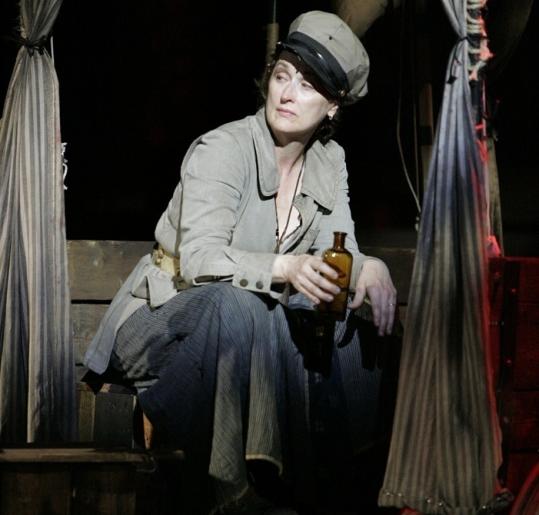
Brechtian philosophy is centered around Brecht's desire to have the audience analyze his plays objectively and to find the meanings in the messages he conveys. He believed that he cannot achieve this if they become emotionally attached to the characters themselves, and allowed their minds to be clouded with that attachment.
I was intrigued as an aspiring scriptwriter, director, and performer that he achieves this not only through incorporating music and harsh lighting, which is typical in Brechtian theatre, but also by the structures of his play. Whenever there is a joyous occasion, the audience is quickly sobered by the next or a parallel scene. Whenever someone is mourning, there is something to disrupt the immersion.
Good Soul of Szechuan

Firstly, I learned about dramaturgy - it was, in fact, my first time I heard of such a profession. I had known in my mind that someone must have done the background research for a play, but I had never thought of it as a profession for a person.
- First experience with production elements; newfound appreciation
- Learned about dramaturgy; its importance in a play; a new interest
- Learned about lighting; learned about different types of lighting and how lighting can so affect atmosphere
- Difficulty balancing practicality and ideas
Andong
[I have decided that I would like to talk of Andong instead]
Commedia del Arte

Romeo and Juliet

What came to mind was the basics - my workshops with Mark Hill in reference to spacial relations, physicality, and the ensemble.
I also thought back to the workshops I had with Daniel Foley regarding Shakespearian language and vocalizations, through which I learned the importance of the language. Playwrights make conscious choices for every word, Shakespeare being no different. Through Romeo & Juliet, I learned the importance of discovering the essence of a character's words and the musicality of the language.
This production was also, in my mind, a demonstration of how theatre evolves with time. The themes in Shakespeare's plays are universal, timeless, and so even in a different setting, it is relevant and plausible. In fact, as time goes on and different values arise, the same centuries old script can reveal different truths about the world it lives in, and can tell different themes to the audience.
Shadowland

I have learned so much about how physical theatre can be, again recalling Suzuki's emphasis on making every moment dynamic and interesting through use of the human body and spacial relations. Shadowland, if not anything else, most certainly succeeds in that.
And more.
Shadowland also is yet another example of how theatre reflects changing times. Shadowland incorporates technology into its performance through the innovative use of strong lighting and shadows, which was not possible in the past.
Salar de Uyuni

Theatre is a world that changes with the world around it. The Salar de Uyuni is constantly changing, the amorphous form of the sky always transforming as time passes and the wind carries the clouds. The world of the mirror reflects that change and evolves with its surroundings. Not only the sky, however - if I stand in the Salar de Uyuni, I am reflected in the mirror as well, with all of my changes. If I stand in the world of theatre, my reflection influences that world as well. Every step I take causes ripples in the water and is reflected in that world.
To me, theatre is reflective, changing, and beautiful in those respects.
Thursday, October 31, 2013
Romeo & Juliet
I have not performed on a stage in years. In my high school career, Romeo & Juliet was my first school production (not counting our class-produced performance of The Good Soul of Szechuan) and from it I have garnered experiences and knowledge that I never would have otherwise.
I had studied IB Theatre at higher level for over a year, participated in numerous workshops from a variety of people, but I had never had an opportunity in which to make use of what I learned. My role as Lady Capulet and just being a part of the Romeo & Juliet cast gave me a chance to change that.
I never knew how exhilarating it was to perform. I had never even imagined it. However, the feeling I experienced once I completed the play was astounding. I don't think that I have ever felt such a sense of accomplishment. The other more experienced members of the cast tell me that they have never been so close after a play before, and I don't doubt it - the sense of camaraderie and trust that we built up is amazing. I have gotten to know people I could never have known without this experience.
And I am grateful.
I had always thought of myself as a girl that lacks commitment. I have countless personal projects I had started but never completed. However, I've learned from Romeo & Juliet that I thought wrong. If I put my heart into it and have people supporting me, and if I make the time to try, I can accomplish amazing things. I can persevere and complete something. I can finish a project and make something great.
I have learned so much about myself and just creativity and cooperation in general.
Wednesday, October 30, 2013
Guest Speaker: David
- Student of Mrs. Moon during the time of the R&J Movie (DiCaprio, 1996)
- The decision process of a director
- brings a world to life
- willing something into existence
- Tische School of Film
- don't necessarily have to go to a school for film; need dedication and determination to learn and train, however
- school is for the people that you meet and the portfolio
- Competitive work environment
- come prepared to set
Before : "THIS WILL BE THE GREATEST THING EVER!"
Later...: "oh my god I just hope it doesn't fail" <-truer words have never been said
- Art is an emotional process. It's natural. -Mrs. Moon
- "You have to finish it" - this is one of the most important aspect of anything, especially art; screenplays, writing, anything. Finish it. Finish it. Finish it.
- It is a miracle that good movies exist.
- "They almost perfected film-making... and then sound came."
- ((Trampolines are always great))
Monday, October 28, 2013
RI - Elements and Notes
- You can include images
- Parenthetical references
- Make every word count
- The more specific, the better
- ((Grotowski's philosophies are fascinating))
- Notes Below the Cut
What The Body Does Not Remember
Firstly, I will express how much regret I have for being unable to watch this performance. The idea of the human body and its reflexes and the unconscious tension - TBC listening to class
Friday, October 25, 2013
IPP: Why Scriptwriting?
My dream is that one day, the characters I create can be real to someone else.
After all, they are already real to me, so I can't help but hope that someone else - complete strangers to me - will one day love them as much as I do. I have written for five years now, and I've always written with one intent: to have the characters that are so real to me to be real to someone else as well.
I have wanted to complete writing a play, ever since my first Scriptwriting Frenzy attempt back in 2009. I never did succeed writing a 100 page play in 30 days, but it was the process that was memorable. I've imagined for a long time now what sheer satisfaction I would feel should I ever complete a work.
I think this IPP is the time for me to do so.
Though I was enjoying myself back then, I was also a child - I wrote for the fun of it, but I wasn't truly driven by passion, nor did I have any knowledge to aid me in the process. Now that I am a student of IBH Theatre, I have read several different plays, seen numerous different performances, and more than ever, I am passionate.
I want to write a play, put the ideas in my head down on paper, and have the characters I create live and die in a world of my creation.
I am a writer, after all.
It's what I do.
Subscribe to:
Posts (Atom)